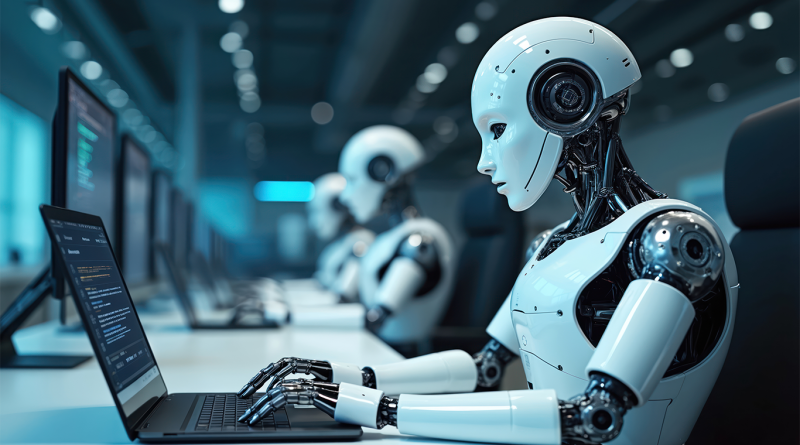
How AI is transforming work and why workforce strategy must follow
Subscribe to our free newsletter today to keep up to date with the latest business news.
Artificial intelligence is reshaping business in ways that rivals the industrial revolution. Leaders from consulting to tech predict that this shift will not just change tools but fundamentally alter roles, workflows and organisational design. Yet the success of AI investments will hinge on how companies prepare the humans working alongside the machines, not just the technology itself.
AI and the emerging hybrid workforce
Across industries, AI tools are evolving rapidly from simple automation scripts to software that can act autonomously and participate in complex workflows. These so‑called digital coworkers or AI agents can understand goals, form multi‑step plans and execute tasks with minimal human supervision, ushering in what many analysts call an agentic workforce.
This new paradigm positions AI not as a back‑office utility but as a collaborator. In practical terms, AI agents can handle data entry, update records, draft communications and even interact with customers, freeing human employees to focus on higher‑value activities like relationship building, strategic problem solving and creativity.
Industry leaders are already investing heavily in this transformation. For example, global firms like Accenture have announced major training programmes to equip hundreds of thousands of staff with agentic AI skills, signalling that upskilling will be a cornerstone of workforce strategy.
Closing the adoption gap
Despite the potential of AI, adoption across organisations remains uneven. Senior leaders are far more likely to use these tools than frontline staff, creating a gap in productivity and impact. In one survey, a large majority of executives reported regular use of AI at work, while adoption among employees lagged significantly.
This gap matters because technology alone does not produce value unless employees know how to use it effectively. Without broad adoption, companies risk creating internal silos where only a select few reap the benefits while most workers remain disconnected from the tools that could enhance their work.
To narrow this divide, companies must democratise access to AI tools and embed training programmes into the fabric of everyday work. Simple steps such as structured training, executive support and contextualised use cases can significantly increase adoption and confidence among employees.
Reframing roles and skills
One of the most profound effects of AI is not job elimination but job evolution. While routine tasks such as scheduling or reporting are increasingly automated, new responsibilities are emerging that centre on overseeing, guiding and collaborating with AI systems.
For many organisations this means a shift from traditional role definitions. Instead of narrowly defined tasks, roles will emphasise judgement, human judgment, empathy, communication and complex problem solving. These are areas where AI still lags and where human workers can add distinctive value.
Upskilling and reskilling are essential in this new landscape. Training programmes designed to build AI fluency, data literacy and human‑machine collaboration skills will not only expand workforce capabilities but also support employee retention and engagement. Employers that treat upskilling as strategic rather than optional are more likely to unlock the full value of their AI investments.
Strategic workforce transformation
A successful strategy for the future of work with AI encompasses more than training. It requires rethinking how work is designed, how teams function and how performance is measured. Leaders must align human and machine capabilities in ways that amplify organisational strengths and address weaknesses.
This means redesigning workflows to integrate AI at every level of the enterprise, from entry functions to executive decision‑making. It means breaking down hierarchical barriers that prevent frontline workers from using AI tools, and reengineering career paths to reward mastery of new competencies.
It also means leadership that embraces transparency, ethical standards and employee empowerment. Clear communication about how AI will be used, what roles will change and what skills will matter can alleviate anxiety and build trust. Leaders must help workers see AI not as a threat but as a partner in delivering greater value to customers and shareholders alike.
Navigating the transition
The analogy to past industrial revolutions is apt but incomplete. Unlike mechanisation in the past, AI is unfolding in real time, compressing change into years rather than decades. This accelerates both opportunity and risk, requiring managers to act with urgency and intention.
Governments, academia and business leaders will also need to collaborate on curricula, incentives and policy frameworks that support broad workforce readiness. Public‑private partnerships can expand access to training and ensure workers are prepared for roles that did not exist a decade ago.
Ultimately, the future of work with AI will depend on how effectively companies navigate the human aspects of this transformation. Organisations that prioritise an inclusive, human‑centred approach to AI adoption will not only drive productivity and growth but also cultivate resilient, adaptable workforces ready to thrive in an era of rapid technological change.
Sources: